
West Palm Beach
24-Hour Towing in West Palm Beach
Had a tire blowout in West Palm Beach? Follow these immediate safety steps, learn when not to change the tire, and prepare for roadside assistance or towing.
Availability and pricing are confirmed on the call.
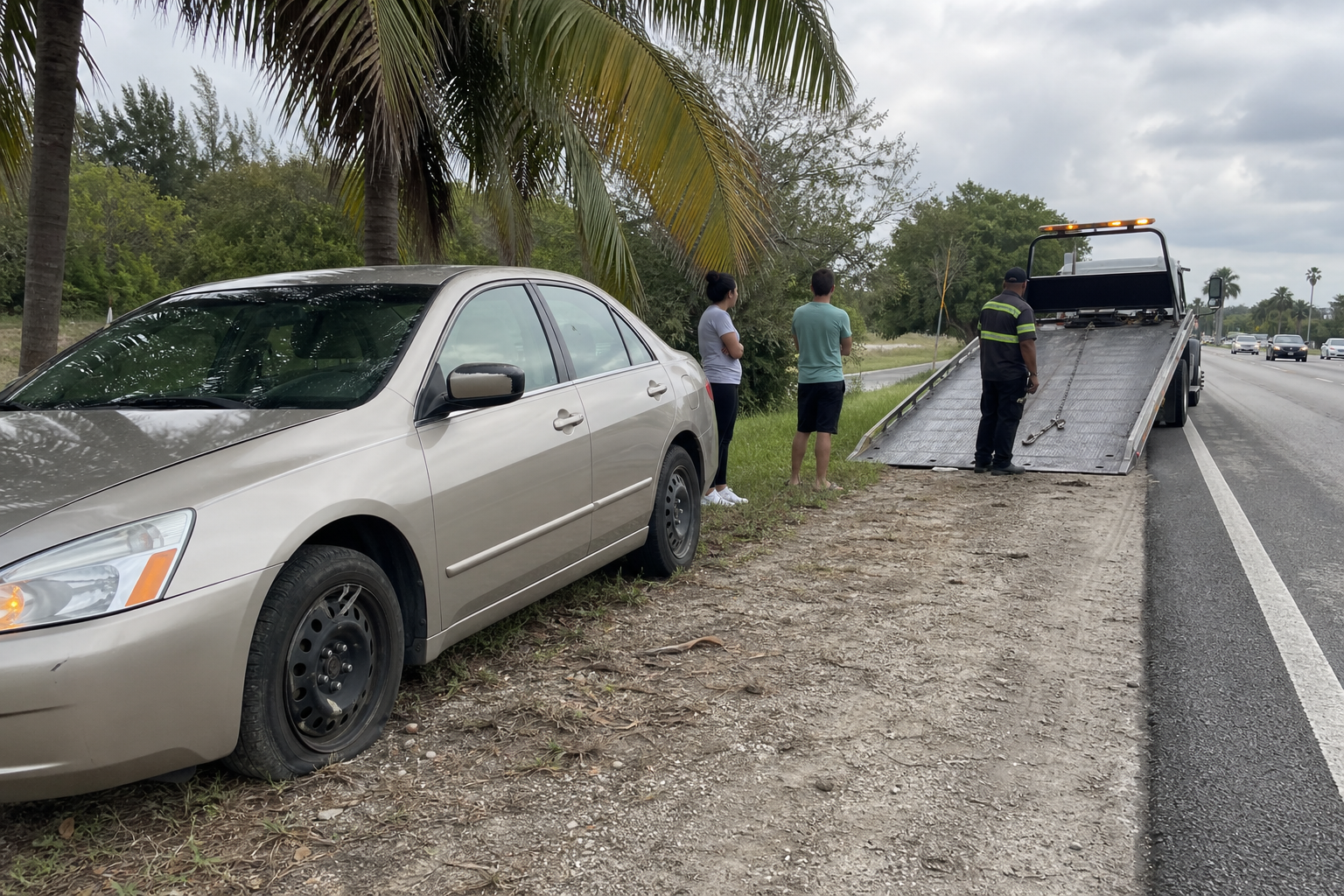
A tire bursts, the steering suddenly feels heavy, and traffic continues moving beside you. Your first job is not to inspect the tire or find the jack. Hold a steady path, reduce speed without abrupt inputs, and look for the safest available place to stop.
Quick answer: stabilize, stop, and stay protected
- Grip the steering wheel firmly. Keep the vehicle pointed where you want it to go.
- Ease off the accelerator. Avoid hard braking or a sudden turn.
- Turn on the hazard lights. Move out of the travel lane only when you can do so under control.
- Stop as far from moving traffic as practical. Set the parking brake and keep seat belts fastened while you assess the location.
- Call for help if the position is exposed. A tire change is not worth standing beside fast-moving traffic.
Smoke or fire changes the plan: Call 911. If occupants can exit without moving into traffic, leave from the side away from traffic, move well away from the vehicle, and do not return for belongings.
Do this—not that
| Do | Do not |
|---|---|
| Slow gradually while maintaining a steady direction. | Slam on the brakes immediately after the blowout. |
| Choose a parking area, wide shoulder, or other space separated from traffic when available. | Stop in a live lane solely to prevent further tire damage. |
| Stay belted inside if exiting would place you near moving vehicles. | Stand beside the failed tire or between the vehicle and traffic. |
| Let the dispatcher know about barriers, gates, narrow access, and your direction of travel. | Assume a map pin alone explains how a tow truck can reach you. |
| Treat identifying the failed tire as optional. | Leave a protected position just to inspect the tire. |
Step-by-step actions after the vehicle stops
1. Decide whether the stopping position is immediately dangerous
Look through the windows before opening a door. Determine whether the vehicle is fully outside the travel lane, partly blocking a lane, around a blind approach, or confined by a barrier. Do not walk around the vehicle to make this assessment.
If the vehicle is exposed to an immediate collision risk, anyone is injured, or there is smoke or fire, call 911. Tell the operator that the problem began with a tire blowout and describe whether the vehicle is blocking traffic.
2. Choose the safer place for occupants
There is no single correct choice for every roadside position:
- Stay inside and belted when exiting would put occupants next to moving traffic and there is no clearly safer place to wait.
- Exit away from traffic only when the doors on that side open into a protected area that occupants can reach without crossing lanes.
- Never wait directly in front of or behind the vehicle. Another impact could move it unexpectedly.
Keep children and pets controlled. Do not allow passengers to gather around the tire or unload luggage on the roadside.
3. Do not begin a tire change until the work area passes a safety check
A spare tire does not make the location suitable for roadside work. A tire change may be reasonable only when the vehicle is completely off the road on firm, level ground with enough separation from traffic for someone to work safely.
Request flat tire assistance or towing instead if any of these apply:
- The failed tire is on the traffic-facing side.
- The shoulder is narrow, soft, sloped, or uneven.
- Part of the vehicle remains in a travel lane.
- You do not have a usable spare, jack, lug wrench, or wheel-lock key.
- The wheel, suspension area, or body appears damaged.
- More than one tire is damaged.
- You cannot confirm that the location is safe enough for roadside work.
Do not crawl under the vehicle, use an improvised jack support, or drive on the damaged tire to search for a more convenient destination. If the car must be moved from an unsafe position, let the dispatcher help determine the appropriate response.
4. Give the dispatcher a location a truck can actually use
For a West Palm Beach call, state West Palm Beach, Palm Beach County, Florida, then provide details that narrow the pickup point. This avoids relying on a broad county label or an imprecise map result.
Dispatcher checklist
- Your phone’s map pin or displayed coordinates.
- The direction the vehicle was traveling.
- The nearest visible cross street, address, or posted location marker.
- Whether the road is divided or separated by a median or barrier.
- Whether the truck must enter through a gate, parking area, or restricted driveway.
- Vehicle year, make, model, color, and drive type if known.
- Whether the vehicle is fully off the road or blocking any part of a lane.
- Visible wheel damage and whether a usable spare and wheel-lock key are present.
Do not walk along the road to find a sign. Relay what you can see from the protected position. If your pin appears inaccurate, tell the dispatcher rather than guessing.
5. Match the help to the condition of the vehicle
Roadside assistance may be suitable when there is a safe work area and a usable spare can be installed. Choose emergency towing when the vehicle is exposed, cannot be safely serviced where it sits, lacks a usable spare, or may have wheel or suspension damage.
A dispatcher may recommend flatbed towing based on the vehicle, damage, access, and manufacturer towing requirements. Mention any unusually low clearance, locked wheel, or loose body panel before the truck is sent.
6. Wait without creating a second roadside hazard
- Keep your phone available and answer calls from the towing provider.
- Leave hazard lights on if the electrical system is functioning normally.
- Do not place warning devices if doing so requires walking close to traffic.
- Do not accept instructions to meet the truck somewhere else by driving on the blown tire.
- When the truck arrives, wait for the operator’s directions before approaching it.
Tire blowout FAQs
Can a tire sealant kit fix a blowout?
Usually not. Sealant kits are intended for limited puncture situations, not a tire with major tread or sidewall separation. Do not attempt inflation if the tire is shredded, off the rim, or visibly deformed.
What if I cannot tell which tire failed?
That is acceptable. Tell the dispatcher how the vehicle behaved and report only what you can see safely. Identifying the tire is optional and never worth stepping into an exposed area.
Will a roadside provider change a tire on a narrow shoulder?
The provider must evaluate whether there is enough safe working space. If the position is too exposed, towing or another relocation plan may be needed instead of an on-site tire change.
What if my spare looks usable but I do not know its condition?
Tell the dispatcher that the spare is present but unverified. Do not remove it or test its pressure if accessing it requires unloading cargo beside traffic. The responding professional can assess it at the scene.
What should I do if the vehicle starts shaking or making new noises after the blowout?
Stop driving once you can reach the safest available position. New vibration, scraping, or steering problems can indicate damage beyond the tire. Report those symptoms so the dispatcher can prepare for towing rather than a simple tire change.
Ready to request help?
Call from the safest available position and begin with your exact location, lane status, and whether anyone is injured. Palm Beach Towing Service can use those details to determine whether the call needs roadside tire assistance or a tow. Stay where the dispatcher can reach you by phone, and do not approach traffic to make the vehicle easier to find.
Let’s talk through it
Where do you
need to go?
Call with your location and vehicle details.