
West Palm Beach
24-Hour Towing in West Palm Beach
Learn the warning signs of a failing car battery, when not to keep driving, and what to do while waiting for jump-start or towing help in West Palm Beach.
Availability and pricing are confirmed on the call.
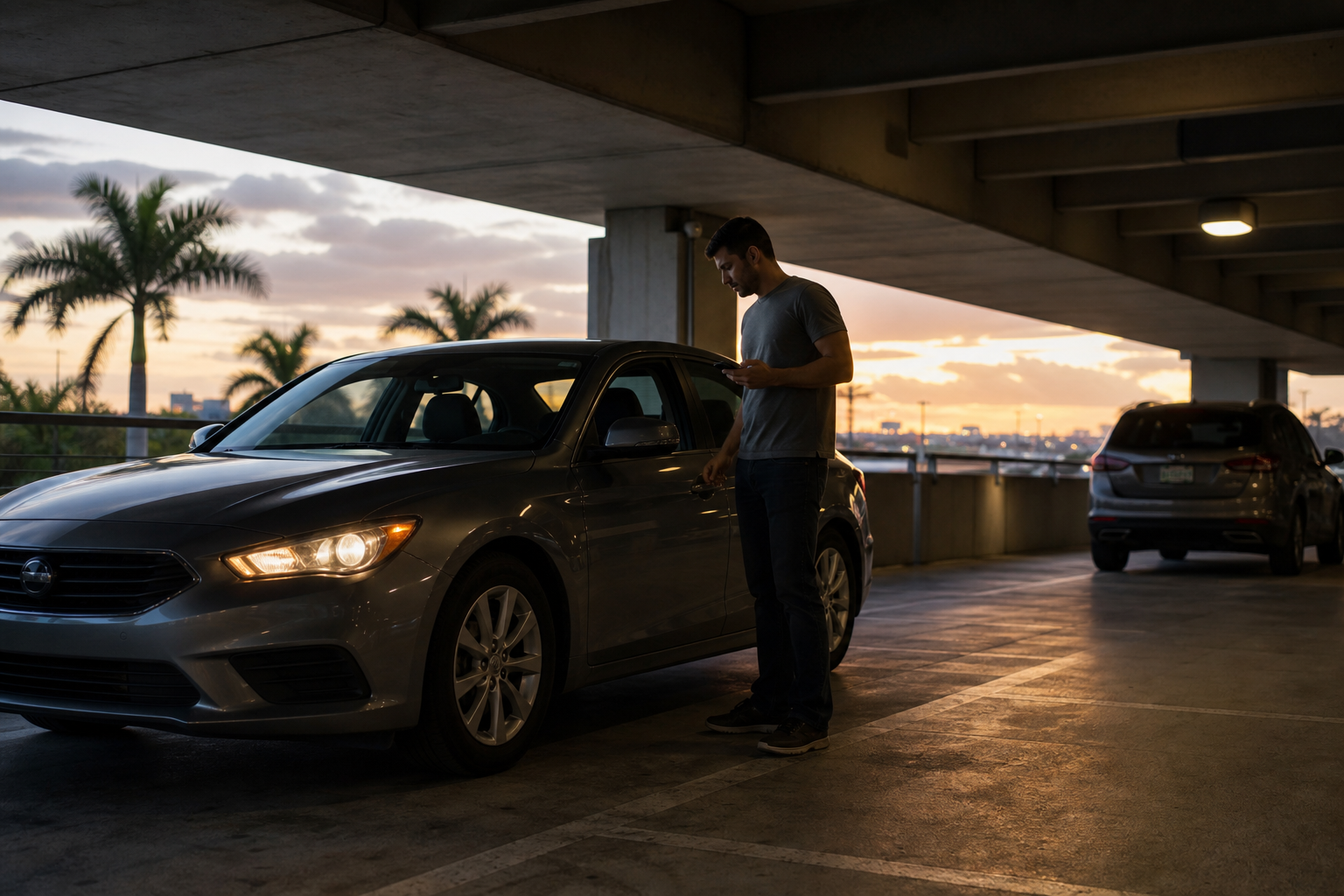
The dashboard lights come on, but the engine gives one slow crank, then another, then only a rapid clicking sound. You may be parked at home, outside a business, or in a West Palm Beach parking garage where another jump-start attempt is not easy to arrange. Before repeatedly turning the key or pressing the start button, use the symptoms below to sort a likely weak battery from a situation that should not be pushed further.
Immediate action: Stop trying to start the vehicle after two or three failed attempts. Turn off headlights, climate controls, chargers, and other accessories. Put the vehicle in park, set the parking brake, and keep your hazard flashers on only if your location requires them for visibility. Repeated starting attempts can drain the remaining battery charge and make the next step less clear.
Match the symptom to the next roadside move
| What you notice | What it can mean at the roadside | Best next move |
|---|---|---|
| The engine cranks slowly, as if it is struggling to turn over. | A weak battery is a common possibility, especially if the vehicle has been sitting or the problem is worse after accessories were used. | Arrange a jump start service. Do not keep cranking the engine repeatedly. |
| You hear rapid clicks, but the engine does not crank. | The battery may not have enough power to engage the starter. Loose or corroded battery connections can produce similar symptoms. | Request roadside help. Avoid touching battery connections if you are unsure how to do so safely. |
| Interior lights, headlights, or the dashboard appear noticeably dim before starting. | Low electrical power points toward a discharged or failing battery, though the charging system can also be involved. | Try no more than one controlled start attempt after turning accessories off. If it fails, call for help. |
| The vehicle starts after a jump but stalls soon afterward, or warning lights remain on. | The battery may not be the only issue. A vehicle that will not remain running may not be dependable to drive. | Do not assume another jump solves it. Request emergency towing if the vehicle stalls or cannot stay running. |
| The engine starts normally, but the battery warning light appears while driving. | This can signal a charging-system issue rather than a simple low battery. The vehicle may lose electrical power while underway. | Reduce electrical load, move to a safe stopping place if possible, and call for towing rather than continuing a long drive. |
| There is a sharp sulfur or rotten-egg odor, visible leaking, swelling, smoke, or unusual heat near the battery area. | These are not routine low-charge symptoms. Battery damage can create a safety hazard. | Do not jump-start the vehicle or handle the battery. Step away from the vehicle and request towing assistance. |
| The vehicle is completely dark: no dash lights, no interior lights, no response. | A fully discharged battery is possible, but so are connection or electrical issues. | Call roadside assistance for a safe assessment and jump-start attempt. If access is difficult or the vehicle cannot be started, arrange towing. |
Stop, continue briefly, or call now?
A battery problem is not always a stay-put emergency, but a no-start situation can change quickly if you are blocking traffic, parked in a restricted area, or unable to exit a constrained-access garage. Use this decision path instead of guessing.
Stop and call for roadside assistance now
- The car will not crank, clicks repeatedly, or loses all electrical power.
- The vehicle is in a garage, airport parking area, or other location where another vehicle cannot safely pull alongside for a jump.
- You do not have jumper cables, do not know the vehicle's jump points, or cannot safely access the battery.
- You are in an unsafe position, such as a travel lane, narrow entrance, or area with poor visibility.
- You see battery leakage, swelling, smoke, or smell a strong sulfur odor.
Continue only long enough to reach a safer stopping point
If the engine has started and is running normally, a short move to a safer nearby location may be reasonable. Keep electrical demand low: avoid unnecessary chargers and turn off accessories you do not need for safe operation. Do not treat a successful jump as proof that the vehicle is reliable for errands, highway travel, or a long drive. If the battery light comes on, lights dim while driving, the engine hesitates, or the vehicle stalls, pull over safely and request towing.
Choose towing instead of another start attempt
Towing is the practical choice when the car cannot remain running, a jump fails, the vehicle has a possible battery safety issue, or you need to move it from an access-restricted location. A flatbed towing option can be useful when the vehicle should be transported without further attempts to drive it.
Roadside checklist while you wait
- Make the vehicle visible. Use hazard flashers when appropriate and safe. At night or in a dim garage, stay aware of moving vehicles around you.
- Stay out of traffic. If the vehicle is safely parked, remain in a protected area. Do not stand between vehicles or in the path of garage traffic.
- Do not keep testing the ignition. Save remaining battery power for hazard lights, interior access, or communicating with help.
- Gather only useful details. Note whether the engine was slow to crank, clicked, started after a jump, stalled, or showed a battery warning light.
- Check your exact location. In a large garage, identify the level, section, nearest elevator or stairwell, and vehicle-facing direction if visible. At an airport parking facility, confirm the lot name and row before calling.
- Keep the keys available. Have the key fob or physical key ready. If the vehicle requires a special start procedure, mention that during the call.
- Do not improvise a jump. Avoid using damaged cables, connecting to unknown terminals, or accepting help that requires blocking a traffic lane.
Prepare for a faster roadside-assistance call
When you contact Palm Beach Towing Service, lead with the no-start symptom and your access conditions. Clear information helps determine whether a jump-start attempt or towing is the better dispatch request.
- Your location in West Palm Beach, Palm Beach, Florida, including garage level, lot section, gate restrictions, or other access limits.
- Vehicle year, make, model, color, and license plate details if available.
- What happens when you try to start it: slow crank, clicking, dashboard lights only, or no power.
- Whether the vehicle started earlier with a jump and what happened afterward.
- Any warning lights, odor, visible battery damage, or stalling.
- Whether the vehicle can be shifted into neutral, if known. Do not force it.
- Your preferred destination if towing is needed.
For a car that will not start, ask specifically for roadside assistance in West Palm Beach and describe the symptom before requesting a particular solution. If the vehicle is unsafe to jump, cannot stay running, or cannot be accessed safely, say that upfront so towing can be arranged appropriately.
Battery warning-sign FAQs
Can a car battery fail without any warning?
Yes. Some batteries work normally until they do not have enough charge to start the engine. Still, slow cranking, dim lights, repeated clicking, and a need for recent jump starts are common signs that should not be ignored.
If my car starts after a jump, can I keep driving?
A successful jump only shows that the engine started with added power. If the vehicle stalls, the battery warning light comes on, or electrical systems dim, stop driving and arrange towing. Even if it continues running, avoid assuming it is dependable for a long trip.
Is clicking always a dead battery?
No. Rapid clicking is often associated with low battery power, but connection and starting-system problems can produce similar sounds. Roadside help can address the immediate no-start situation without relying on a guess.
Should I jump-start a swollen or leaking battery?
No. Do not attempt to jump-start, handle, or closely inspect a battery that appears swollen, leaking, smoking, or unusually hot. Move away from the immediate area and request towing assistance.
What should I do if my car will not start in a parking garage?
Confirm the garage name, level, section, and closest access point. Tell the dispatcher about clearance limits, gate access, and whether the vehicle is blocking a lane. This information is especially useful when arranging roadside assistance or towing from constrained-access parking.
Let’s talk through it
Where do you
need to go?
Call with your location and vehicle details.