
West Palm Beach
24-Hour Towing in West Palm Beach
Stranded on I-95 in West Palm Beach? Learn how to report mile markers, exits, cross streets, direction, and shoulder position to towing dispatch.
Availability and pricing are confirmed on the call.
The highest-risk mistake is leaving a protected vehicle to walk along the shoulder—or crossing active lanes—to find a marker. The safer alternative is to stay in the best protected position available and build your location from signs you already passed, the direction you were traveling, your phone map, and anything visible without moving toward traffic.
Do this now
- Move as far out of the travel lane as the vehicle can safely go and turn on the hazard flashers.
- If the vehicle is in a live lane, has been struck, is smoking, or anyone is injured or medically distressed, contact emergency services first.
- Do not walk back to a mile marker. Do not cross the highway to reach a sign or a more shaded area.
- Call for emergency towing or roadside assistance with the road, direction, last confirmed exit, and shoulder position.
Before the problem: know which clues solve different dispatch questions
A dispatcher is not looking for one perfect address. On a limited-access road, the useful answer is a compact location packet. Each clue answers a different question:
- Road name: Which highway should the operator enter?
- Direction: Which separated side of the highway—northbound or southbound—contains the vehicle?
- Mile marker: Where along that highway is the vehicle?
- Exit or cross street: Which interchange should the operator use, and is the vehicle before or after it?
- Shoulder position: Will the operator find the vehicle on the right shoulder, left shoulder, ramp, or another accessible area?
Before driving, enable location access for your map application and learn how it displays your current road and travel direction. This preparation should reduce roadside movement, not encourage it. A phone pin helps confirm a report, but it should not replace a plain-language description that a driver can follow.
At the roadside: build a West Palm Beach location packet
Consider a vehicle stopped on northbound I-95 in West Palm Beach after passing the signed Okeechobee Boulevard interchange at Exit 70 but before reaching Palm Beach Lakes Boulevard at Exit 71. A useful first report is:
“I am on I-95 northbound in West Palm Beach, past Exit 70 for Okeechobee Boulevard and before Exit 71 for Palm Beach Lakes Boulevard. I am fully on the right shoulder.”
That statement gives dispatch a bounded highway segment, the correct carriageway, and the side where the vehicle should appear. If a mile marker is already visible from the vehicle, add its complete number. Do not omit a decimal or smaller digit if one is shown, and do not call an exit number a mile marker.
If you know only one nearby street, describe your relationship to it precisely:
- “I just passed the Okeechobee Boulevard exit” is useful.
- “I am before the Palm Beach Lakes Boulevard exit” is useful.
- “I can see an overpass ahead, but I cannot read its sign” is limited but honest.
- “I am at Palm Beach Lakes Boulevard” is misleading if you are actually on I-95 beneath or beyond the overpass.
A cross street seen from the highway does not automatically provide direct access to your shoulder. The operator may need the preceding or following interchange. Tell dispatch whether the street is an exit, an overpass, or simply a name shown by your map.
Use this checklist while speaking with dispatch
- Highway: exact road shown on signs or the map
- Direction: northbound or southbound
- Nearest mile marker: only if safely visible
- Last exit passed: street name and exit number, if known
- Next exit ahead: street name and exit number, if known
- Position: right shoulder, left shoulder, exit ramp, entrance ramp, or travel lane
- Vehicle: color, body style, and any feature visible from traffic
- Need: tow, jump start, or flat tire service
- Immediate hazard: lane blockage, smoke, collision damage, poor visibility, or a person in distress
Avoid “inside shoulder” and “outside shoulder” unless the dispatcher uses those terms and confirms them. “Left shoulder beside the median” or “right shoulder beside the exit side” is harder to misunderstand.
While waiting: preserve the location instead of searching for a better one
Remain belted inside if the vehicle is fully out of traffic and staying there is the safer option. If remaining inside presents an immediate danger and a clearly protected location can be reached without crossing active lanes, leave through the side away from traffic when possible. Never stand beside the traffic-facing door, behind the vehicle, or between the vehicle and a barrier.
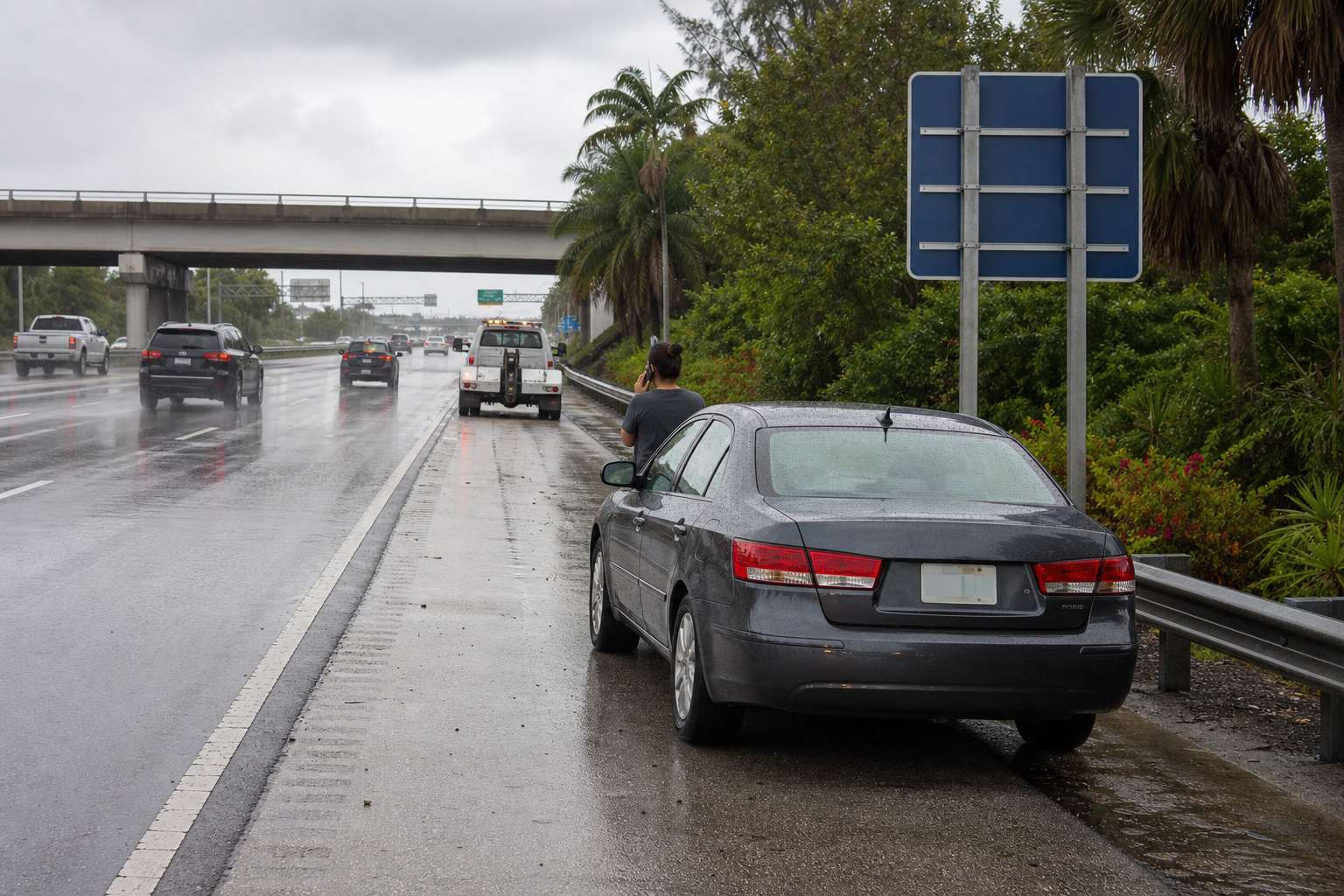
South Florida rain can quickly reduce how well approaching drivers see a stopped vehicle. Do not step onto a wet shoulder to photograph a marker or wave down the tow operator. In strong West Palm Beach heat, tell dispatch if the temperature is creating a medical concern; do not cross lanes or walk along I-95 in search of shade.
Keep the phone available. Send a location pin if requested, but confirm that the pin rests on the correct side of the divided highway. If the map places you on a nearby street, say so rather than letting the pin override your highway description.
Update dispatch if:
- the vehicle must be moved from the reported position;
- you realize the travel direction or exit sequence was wrong;
- rain or darkness has made the vehicle difficult to see;
- the situation changes from a roadside service request to a towing need; or
- a new immediate hazard develops.
After service arrives: let the operator control the roadside approach
Do not step into the shoulder to meet an approaching truck. Stay in the protected position and confirm by phone that the operator sees your vehicle. The operator may need to pass, use an interchange, and approach again from the correct direction; separated highway lanes often prevent a simple turnaround.
Once instructed that it is safe, identify the service requested and mention anything affecting loading or access. If the vehicle requires transport rather than an on-scene service, confirm the destination and whether flatbed towing is being provided. Follow the operator’s directions about where to stand or sit during hookup.
Choose the call based on the vehicle’s position
- Fully off the roadway with no immediate danger: call towing or roadside assistance and provide the complete location packet.
- Unsure whether the vehicle can be serviced safely where it sits: tell dispatch the exact shoulder or ramp position and let the operator assess the equipment needed.
- Stopped in an active lane, involved in a collision, smoking, or facing an injury or medical emergency: contact emergency services first, then arrange towing when directed or when the immediate hazard is addressed.
Decision point: If you can name the highway, direction, most recent exit, and shoulder, call now. If any one of those details is uncertain, say “unknown” and give the clues you can verify without leaving safety.
Frequently asked questions
Is an exit number the same as a mile marker?
No. Exit numbers identify interchanges; mile markers identify positions along a route. Report exactly what the sign says instead of converting one into the other.
What if I passed the sign before the vehicle stopped?
Report it as the last sign passed and name the next known exit if available. “Past Exit 70 and before Exit 71” is more useful than guessing a mile marker.
Should I walk to the nearest cross street?
No. Do not walk along a limited-access shoulder or cross active lanes to improve your description. Use your map, visible signs, and the last interchange you remember.
Can a phone location pin replace road direction?
No. Pins can fall on the wrong carriageway or a nearby surface street. Send the pin if requested, then state the highway, northbound or southbound direction, nearby exit, and shoulder position aloud.
What if I do not know which direction I was traveling?
Do not guess. Tell dispatch the last exit or street name you passed, the next sign you can see, and any destination shown on highway signs. The dispatcher can use those clues to clarify your direction.
Let’s talk through it
Where do you
need to go?
Call with your location and vehicle details.