
West Palm Beach
24-Hour Towing in West Palm Beach
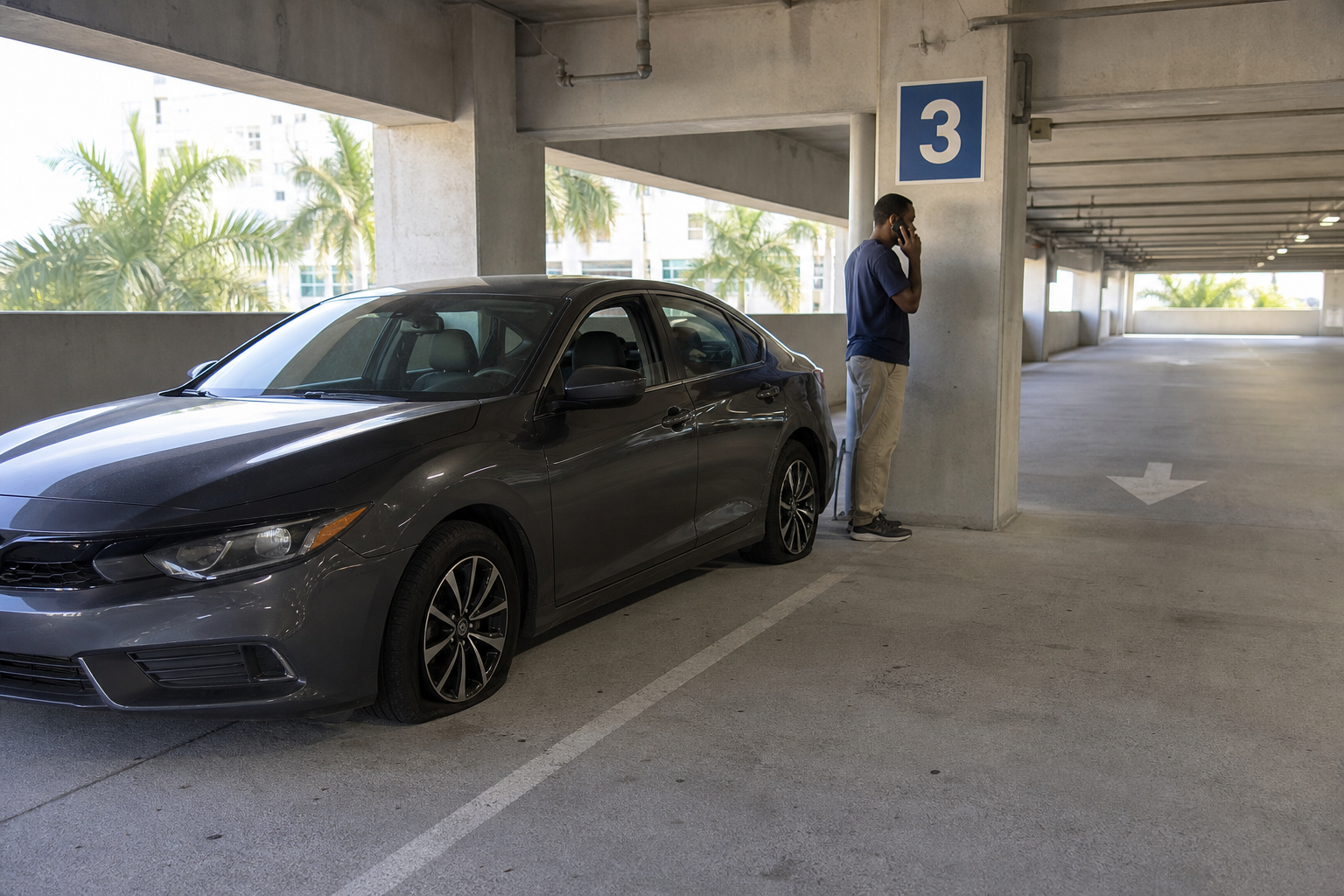
Flat tire in a West Palm Beach parking garage? Use this checklist to decide whether to move, what details to share, and how to prepare for roadside assistance or flatbed towing.
Availability and pricing are confirmed on the call.
The highest-risk mistake is trying to drive a vehicle with a fully flat tire through a parking garage to reach an exit. A flat tire can damage the wheel, make steering unpredictable, and leave the vehicle stuck in a tighter or less accessible spot. The safer alternative is to stop in the first reasonably safe location, turn on hazard lights if appropriate, and gather precise garage-access details before requesting help.
A parking garage changes the roadside-assistance process. The vehicle may be below street level, behind a gate, near a low-clearance ramp, or in an area where a standard tow truck cannot safely enter. For drivers in West Palm Beach, Palm Beach, Florida, accurate location and access information can help the dispatcher determine whether a tire service technician, a smaller service vehicle, or flatbed towing is the better fit.
Situation matrix: identify the flat-tire problem before moving the vehicle
| What you see or notice | Likely concern | Best immediate step | Information to report |
|---|---|---|---|
| Tire is completely flat, compressed against the pavement, or the wheel appears close to the ground | Driving can harm the wheel and may make the vehicle harder to control | Do not continue toward the exit unless remaining where you are creates an immediate hazard | Tire position, vehicle location, garage level, nearest ramp or entrance |
| Tire is low but still holding shape, and the vehicle is in an active driving lane | You may need to move only far enough to clear traffic or reach a safer nearby space | Move the shortest practical distance at very low speed only if the tire is not fully collapsed | How far the vehicle was moved, current location, whether the tire lost more air |
| A nail, screw, or other object is visible in the tread | Removing it can cause faster air loss | Leave the object in place and avoid driving on the tire | Visible object location and whether the tire is holding any air |
| Sidewall is cut, bulging, torn, or scraped from garage contact | A sidewall issue is not a simple temporary inflation situation | Stop and request assistance; do not attempt to drive out on that tire | Sidewall damage, tire position, and available clearance around the vehicle |
| Vehicle is parked in a narrow stall, against a wall, or beside a column | Limited working room may prevent safe tire service | Do not reposition the vehicle on a flat tire just to create space | Which side has the flat, distance to wall or column, and whether doors can open |
| Vehicle is on a ramp, near a turn, or blocking a garage lane | Traffic exposure and slope can make a tire change unsafe | Use hazard lights if safe, keep clear of moving traffic, and call for help promptly | Ramp or lane position, direction of travel, traffic conditions, and safe waiting area |
| No usable spare tire, missing wheel-lock key, or uncertainty about tire tools | On-site spare installation may not be possible | Tell the dispatcher before service is assigned | Spare availability, wheel-lock key status, and whether you need towing |
Stop or continue? A garage-specific decision
Stop and request help now if the tire is fully flat; the wheel or tire sidewall is damaged; the vehicle is on a ramp or in a narrow area; the flat is on the side closest to a wall, column, or moving traffic; or you do not have a usable spare and safe tools. A roadside technician may be able to install your spare if conditions allow. If the vehicle cannot be safely serviced inside the garage, flatbed towing may be needed to move it without adding tire or wheel damage.
Continue only a minimal distance if the tire is still visibly inflated, the vehicle is creating a direct traffic obstruction, and there is an immediately nearby safe space. Drive slowly, avoid sharp turns, and stop as soon as the vehicle is clear of the travel lane. Do not make a long trip through multiple garage levels in search of an exit.
If you are unsure whether the tire is merely low or fully flat, treat it as flat. The goal is not to diagnose the tire in the garage; the goal is to keep the vehicle stable and give the service provider enough information to arrive with an appropriate plan.
Roadside checklist: secure the scene and collect the details
- Park as safely as the location allows. Shift into park, apply the parking brake, and turn the vehicle off. Avoid standing in a vehicle lane, on a ramp, or between your vehicle and a wall.
- Use hazards thoughtfully. Hazard lights can help nearby drivers notice a stopped vehicle. If lighting or traffic conditions make the garage unsafe, move yourself to a protected pedestrian area when possible.
- Find the garage identifier. Look for the garage name, building address, entrance street address, level number, color zone, section letter, bay number, or space number. Take a photo of signs if that is faster than writing details down.
- Identify the vehicle precisely. Have the year, make, model, color, license plate, and the tire position ready: front driver-side, front passenger-side, rear driver-side, or rear passenger-side.
- Check the spare without unpacking the whole vehicle. Confirm whether a spare is present and accessible. Note if it appears low, damaged, or unavailable. Do not crawl under the vehicle or begin jacking it up in a cramped travel area.
- Locate keys and special wheel equipment. If your vehicle uses a wheel-lock key, find it. Tell the dispatcher if you cannot locate it, as a tire service attempt may be limited without it.
- Check phone signal and battery. Garages can weaken reception. If possible, call from an area with stronger signal while staying close enough to direct the technician. Keep your phone charged and available for arrival coordination.
- Ask garage staff only for access facts. If staff are available, ask for the vehicle entrance, clearance information they can provide, gate instructions, and the best place for a service vehicle to enter. Do not assume a truck can use the same entrance as passenger cars.
Service preparation: the information to share on the call
Start with the location before describing the tire: “I am in a parking garage in West Palm Beach, Palm Beach, Florida.” Then provide the garage address or name, your level and section, and the entry route a service vehicle should use. A dispatcher needs enough detail to match the request to the garage’s physical access—not simply the address pinned on a map.
- Garage access: Name of garage or property, street address, vehicle entrance location, level, zone, space number, and any gate or call-box instructions you know.
- Clearance and route: Share posted clearance if visible, whether the vehicle is below ground or on an upper level, and if ramps are tight, steep, or sharply curved. Do not estimate clearance if no sign is available.
- Vehicle condition: Say which tire is flat, whether it is completely deflated, and whether there is visible sidewall or wheel damage.
- Vehicle setup: Provide year, make, model, color, and whether it is parked normally, on a slope, in a compact space, or near an obstruction.
- Spare and tools: State whether you have a usable spare, wheel-lock key, and access to the cargo area or trunk. If you need a spare installed, ask about flat tire service.
- Your safe meeting point: Explain where you can meet the technician: beside the vehicle, at a pedestrian entrance, or at a garage entrance. Keep the phone number used for the request available.
Use a clear call script: “My car has a fully flat rear passenger-side tire. It is on level two of a parking garage in West Palm Beach, Palm Beach, Florida. The vehicle entrance is at [address or entrance detail]. I am in [zone/space], the car is beside [column or level marker], and I have [a usable spare/no spare/a wheel-lock key]. Please confirm what access details the driver needs.”
If the garage cannot accommodate the assigned vehicle, do not try to force the situation by driving out on the flat. Ask the dispatcher what vehicle type or next step is appropriate. For a vehicle that needs to be moved from a difficult location, 24-hour towing can be requested with the garage details already prepared.
Before the service vehicle arrives
- Keep the vehicle keys, registration details if needed, wheel-lock key, and spare-access instructions together.
- Do not remove lug nuts or place a jack under the vehicle unless you are in a stable, open area and know the designated lift points.
- Keep passengers out of traffic lanes and away from the side of the vehicle with the flat tire.
- Watch for a call or text from the service provider, especially if garage reception is inconsistent.
- If your exact position changes, update the dispatcher immediately with the new level, zone, or entrance detail.
Information-ready next step: Before requesting roadside help, have the garage address, level or zone, vehicle entrance details, flat-tire position, vehicle description, and spare status in front of you. That preparation helps Palm Beach Towing Service assess whether roadside assistance or towing is appropriate for your parking-garage location.
Questions drivers commonly ask
Can roadside assistance change a tire inside a parking garage?
It may be possible if the vehicle is in a stable, accessible space with enough room to work safely and you have a usable spare. Tight stalls, ramps, low clearance, active traffic lanes, and damage beyond a simple flat can change the service approach.
Should I drive to the garage exit if the tire is flat?
Usually, no. A fully flat tire should not be driven through a garage simply to reach an exit. Move only the shortest necessary distance if the tire remains inflated enough to do so and the vehicle is blocking an immediate hazard.
What if I do not know the garage clearance?
Tell the dispatcher that clearance is unknown and look for posted signs near entrances or ramps. Share the garage level and access route instead of guessing. This can help determine what service vehicle may be suitable.
What if I have no spare tire?
Say so during the initial request. A technician cannot install a spare that is not available, and the vehicle may need a different service plan. Do not attempt to continue driving on a fully flat tire.
What detail helps a technician find me fastest?
The most useful combination is the garage address or name, the vehicle entrance, your level and zone, a nearby column or space marker, the vehicle color and model, and a phone number where you can be reached.
Let’s talk through it
Where do you
need to go?
Call with your location and vehicle details.